Showing posts with label astronomy. Show all posts

20 January 2016

Earth-Sun distance and Chandler Wobble

Continuing from The Pacemaker of the Chandler Wobble, Grumbine 2014:

The Chandler Wobble (CW) is a small variation in the orientation of the earth’s rotational axis [Chandler, 1891]. It has a period near 433 days [Liao and Zhou, 2004] (0.8435cycles per year, 0.0023095 cycles per day). Some source of energy for the Chandler Wobble  must exist because it dies out on a time scale of decades [Munk and MacDonald, 1960] if energy is not continuingly added. Gross [2000] found that atmosphere-ocean forcing on the earth’s rotation, computed in an ocean general circulation model driven by observed  meteorological parameters, provided that forcing. [O’Connor et al., 2000] also found wind forcing of the ocean to drive the pole tide. This source was questioned [Wunsch, 2001] partly on the grounds that the ocean was displaying a very narrow band response, but there was no reason to believe that the forcing itself was narrow band.

I suggest that the atmosphere-ocean variability near the Chandler Wobble period, among others, is paced by variation in earth-sun distance. The earth-sun distance, in addition to annual and semi-annual variations due to the elliptical shape of the earth’s orbit, varies due to perturbations from the moon (29.53 day period and others), Venus (292, 584, 417, 1455, ... days), and Jupiter (399, 199, 439, 489, ... days). The size of these variations is small, the largest being the 29.53 day lunar synodic period (31*106 Astronomical Units), amounting to approximately 0.08 W/m2 on a plane perpendicular to the sun at the top of the atmosphere. See Table 1 for more precise periods and the amplitudes of distance variations corresponding to them.

Horizons [Giorgini et al., 1996] was used to provided 6-hourly earth-sun distance and osculating elements for 1 Jan 1962 00 UTC through 31 Dec 2008 18 UTC. Table 1 was derived by harmonic analysis of those data at precise frequencies to determine purely cyclic variations in the earth-sun distance. The leading terms are, of course, the annual and semi-annual cycles from the elliptical orbit. Following this, however, are perturbations in Earth-Sun distance due to the moon, Venus, and Jupiter. Note that the orbital elements are not precisely locked to the periods given. The osculating (instantaneous) orbital elements vary; the osculating year varies from 364 to 366 days, for instance [Giorgini et al., 1996]. Consequently, there are residuals near the annual period. But they are far smaller than the main line. The anomalistic year, 365.259635 days [Observatory and Observatory, 2001], is the period between successive perihelia. This has been found to be the appropriate period for climate temperature analysis rather than the tropical (vernal equinox to vernal equinox) year [Thomson, 1995]. As we will be drawing the conclusion that earth-sun distance is important, even for small variations, the anomalistic year is the self-consistent one to use here. 

Previous analyses of orbital variation at relatively high frequency (high compared to, e.g., Milankovitch periods [Milankovich, 1941]) have used annual average orbital parameters [Borisenkov et al., 1985; Loutre et al., 1992], precluding them from examining periods shorter than 2 years and aliasing some of the periods examined here. Also, those works were examining the earth’s tilt, rather than earth-sun distance. Gravitational torques have been examined previously as the main driver of the Chandler Wobble and rejected [Munk and MacDonald , 1960; Lambeck , 1980], which means only non-gravitational external forces, such as earth-sun distance, force Chandler Wobble at these periods, if any external sources do. 

17 February 2015

Chandler and the Chandler Wobble

The fact that the earth wobbles was expected/predicted long before it was observed, which makes for a couple stories about the nature of science and the people who do it.  The story of the Chandler wobble starts up almost a century before Chandler was born.  In 1765, the Swiss mathematician Leonhard Euler, whose name appears throughout mathematics and physics, was examining the mathematics for conservation of angular momentum on a rotating spheroid -- i.e., something like the earth.  It turned out that such a body could have a wobble on top of its regular rotation.  Given what was known about the shape of the earth then, Euler predicted a period for his wobble of about 305 days.  (Modern information doesn't change this number much.)

The magnitude of such a wobble could also be estimated from the law of conservation of angular momentum, and was somewhere around 0.1 seconds of arc.  That made for a difficult observation in 1765, and it wasn't until 1841 that astronomers started trying to observe this 10 month (305 day) wobble.  Given data analysis methods of the day -- pencil and paper -- analyses were done looking to see if there was a signal with a 10 month period.  No such signal was found, even though several people looked.  Side note being that one of the astronomers who looked in to this was Friedrich Bessel, who was the first person to measure the parallax (thence distance) to a star.  Quality of observing skill was not an issue in his failure to detect the wobble. 

Enter, then, in the late 1880s the next start of our story, and some options of how to tell it.  I could tell the story about a 'lone genius, toiling in obscurity until his great moment'.  It would be doing some fair amount of violence to reality, but that hasn't stopped all story tellers.  Chandler was indeed not being paid to do science.  He made his living as a merchant.  But keep in mind, though, that in the 1800s, 'scientist' even as a label was fairly new, and very few people who were scientists, or rather, who were doing science, did it full time.  Many were men of independent means who used their free time to try to understand the world.

Chandler was one such, but his roots in astronomy extended far back -- to high school.

09 February 2015

The earth wobbles

The earth wobbles about in its rotation.  This was predicted long before it was observed, which is a story itself that I'll tell later.  For now, consider the earth and its rotation.  The north pole of the earth points towards the north star, and rotates once per day.  Open your right hand.  Your thumb points north, and when you close your fingers, they are moving in the direction of the earth's rotation.  With your arm making a right angle at the elbow, hand aiming away from your torso, you have an x-y coordinate system.  When you rotate your forearm, that moves your thumb in the x direction (positive or negative), when swing your arm forward/backward, that's the y direction.

The thing is, the earth (your thumb) doesn't always point in exactly the same direction.  There's a small bit of variation.  That's the wobble.  Since astronomers make their observations from the earth, it's very important to know exactly where the earth is pointing at any instant.  This lead (over 100 years ago) to the foundation of the IERS -- International Earth Rotation and Reference Systems Service.  Daily data from 1 January 1962 to (very nearly) the present are available at http://datacenter.iers.org/eop/-/somos/5Rgv/getTX/213/eopc04_08.62-now
Two things stand out to me in looking at this: There's a very slow tendency to increase x and y over time (increasing movement of the north rotational pole away from the original 0 point), and the more dramatic periodic variation.  The business of having slowly varying amplitude (size of the up and down) for the fast variations suggests a 'beat' is going on.  Namely, there are two different periodic variations going on.  When they're both at maximum, you get a large amplitude.  When they're at minimum, you've got a small amplitude.

16 March 2012

Jupiter and Venus

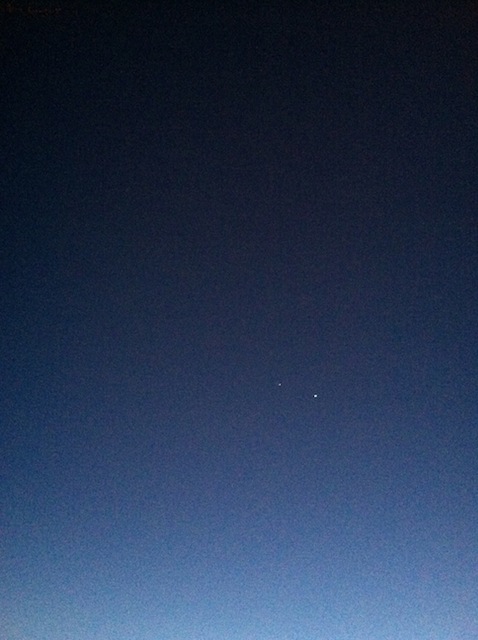
If you've been looking in a generally westerly direction in the early evening, you've, no doubt noticed the two exceptionally bright 'stars'.  Those are Jupiter and Venus, also exceptionally close to each other.  On one view, they're awfully close -- about 3 degrees, or 1/30th of the distance between directly overhead and the horizon.  To a different view, however, they're very far apart -- about 6 full moons would fit between them.

Technology keeps advancing.  In the 1970s, it was about all I could do to get a photograph of a nearly full moon through my telescope.  A fair amount of patience was needed to get the focus right, avoid contaminating light, and so forth.  Below is my phone photo of Jupiter (the fainter one) and Venus.  I was in a well-lit parking lot, and it wasn't much past sunset (hence the bright lower portion of the photo), and had just aimed the phone in the general direction of the planets.


I'll invite you all to contribute your own photos of the planets. 

29 July 2011

Odds and Ends -- July 2011

A number of interesting items that are a little more time-related than I normally talk about.

Some sociology for amusement:
Nation's Climatologists Exhibiting Strange Behavior h/t Michael Tobis.

Regarding some of Roy Spencer's latest Well, give me more than 30 parameters, and I can fit a trans-dimensional lizard-goat ... by Barry Bickmore. I've downloaded the other recent paper and will take it up as my time and interest permits. A couple people have already asked about this, so read Barry's notes in the mean time.

Some fun science, and a reminder to beware of gifts bearing Greeks:
Phil Plait on Earth's first Trojan Asteroid
... and the NASA press release on it.

Trojan asteroids do not, it turns out, contain Greeks. Apparently that is limited to a horse in the Iliad. What happens is that if you have two bodies that are very much more massive than a third, like, say, the Sun and Earth compared to an asteroid, you can park an asteroid on the earth's orbit, but 60 degrees ahead or behind. And it will pretty much stay there. The 60 degrees ahead or behind are called the 'Trojan points'. We've long known of bunches of Trojan asteroids for Jupiter. As Phil's title suggests, this is the first time we've found one for the earth.

That's a bit about the doing of science: There was every reason to believe that the Earth had trojan asteroids. It would actually have been quite remarkable if we didn't -- gravity is supposed to work the same way for us as for Jupiter (allowing for the fact that we're so much less massive). Still, we're happier to see what we expected.

17 March 2011

Where is north?

Where is north is actually intensely tied to the question of What is a day?.  At least we wind up defining it in much the same way(s) as we define the day.  In the previous post, I gave a definition for north/south.  Namely, the line of a shadow cast by the sun at solar noon (itself define by the fact that it's the shortest shadow of the day) is north/south.

As happened for the day, we find our most accurate definition from examining the stars other than the sun.  The 'pole star' isn't actually one that we use for this.  It's almost a full degree away from the actual pole of the earth's rotation.

What we do instead is look for day to day differences in the location of stars passing overhead or nearly so.  This approach dates farther back than Seth Carlo Chandler, in the 1890s.  But we'll be coming back to Chandler.  If the earth has wobbled a little to the north, then the star will pass the zenith a little to the north of where it did yesterday.  If you've got a good telescope and other instruments, you can observe this to pretty good precision.  Chandler was working with accuracy of 1 second of arc or somewhat better for single measurements.  Because of the power of using multiple measurements he was able to examine earth wobbles that were less than 0.1 seconds of arc.

This turned out to be quite useful, as the earth wobbles by about 0.3 seconds of arc.  It's how he discovered what was promptly called the Chandler Wobble.  This translates to about 3 meters motion in where the pole is.

The orientation of the earth is, as with the rotation rate, tied to where the mass is and where it moves to.  The earth's orientation is believed to have changed by some millionths of an arc second due to the earthquake.  The variations of a few tenths of a second of arc are caused by ... other things.  Atmosphere and ocean circulations are what I'm most concerned about, but also the earth's inner core, and the moon, and ....  It's a messy business.

As for the length of day, your scientific source for observations is the International Earth Rotation Service.  Which, itself, owes something to Chandler.

16 March 2011

What is a day?

Some friends have been puzzled about how an earthquake or a tsunami could change the length of a day.  This question comes, of course, from the tremendous earthquake in Japan.  I trust you're all aware of it, the severity, and are doing what you can.  Given how late I am to comment at all, I'll take up my friends' puzzlement.

As is common in science, once you get detailed about just what you are talking about, you also understand much about the thing.  So: What is a day?  There are really at least 4 different definitions of 'day' that we can fairly easily point to.  Only two of them are still in serious scientific use.  One is commonly used, kind of.  And the one with the longest history is no longer in use.

What we need, in order to define a day, is something that takes 1 day to happen.  The longest history for a meaning of 'day' is: "The time between maximum elevations of the sun."  Almost equivalent would be time between sunsets or sunrises.  Maximum elevation of the sun is a much easier and accurate measurement to make.  Don't look at the sun!  You also don't need to.  Get yourself a stick and put it straight in to the ground (on a desk, sheet of paper, ...).  Be sure that the ground is flat and the stick is vertical.  Every so often through the day, mark where the shadow ends.  At some point, the shadow will reach its greatest shortest length.  That's solar noon.  The direction of the shadow (if you're in the northern hemisphere mid or high latitudes) is north.  (There's more fun to be had by repeating this exercise many days through the year.)

This notion of 'day' is affected by earthquakes, since it depends on how fast the earth is rotating.  (This also makes it one of the more obscure ways of showing that the earth does rotate.)

20 August 2010

Bad Astronomy: The Wonders of the Universe

Somewhat in the vein of asking about links that you-all think might be good to add to the blogroll (I'll get there, honest!), I'll mention a blog that I read and isn't on the blogroll.
One such is Phil Plait's Bad Astronomy. Not that he needs the advertising, but I do read and enjoy his blog for reasons relevant to my own aims here. Namely, he regularly has articles (I'll list a few below; apparently 'dozen' should follow the 'few') that illustrate my own feeling -- that the universe is a wonderful and interesting place, and doing science is a way to embrace that wonder.

16 April 2010

Solar Science and Solar Cycle 24

Time for the sun!  Coincidence had a question about solar cycle 24 (what is it, how long are they) hitting my email box the day before I ran in to an astronomer friend who is working with the recently-launched solar dynamics observatory.

For the first, the obvious answer is the correct -- this is the 24th time since records started that the solar cycle has been on the increase.  'solar cycle increase' meaning, in part, the sunspot counts are increasing.  But the sun does a lot more than just get spots.  The Space Weather Prediction Center keeps an eye on the sun, including these other things (go have a look, see the sun as if you had x-ray vision!).  And, naturally, tries to predict things that are influenced by solar activity.  The cycles average something like 11 years, but vary greatly from cycle to cycle (8-15 years).  The activity minimum we are now leaving was unusually deep and unusually long.

On the second, I'll mention that he (William Bridgman) blogs at Dealing with creationism in astronomy.  An article that I'll be taking a look at, and encourage the more technical readers to do likewise, is his The Cosmos in Your Pocket: How Cosmological Science Became Earth Technology. I 
Here's his abstract:
Astronomy provides a laboratory for extreme physics, a window into environments at extremes of distance, temperature and density that often can't be reproduced in Earth laboratories, or at least not right away. A surprising amount of the science we understand today started out as solutions to problems in astronomy. Some of this science was key in the development of many technologies which we enjoy today. This paper describes some of these connections between astronomy and technology and their history.

28 November 2009

Science Anniversaries

150 and 400 years ago, two major events in the history of science occurred.

400 years ago, the telescope was invented and started to be used for astronomy.  For $100-$150 you can now get a telescope far superior to what Galileo used to carry out a major revolution in our understanding of the universe.  More in a moment.

150 years ago yesterday (November 27th), Charles Darwin's On the Origin of Species by Means of Natural Selection was published. Different major revolution in our understanding of the universe.  You can read this for yourself.  I don't actually recommend reading it unless you are really interested in history of science, and like Victorian-era writing.  (If you like my style, you're a couple steps in that direction.  My wife noted that I write something like Trollope, a prolific Victorian whom she likes.)  We've learned an awful lot in the 150 years since then, and many things that were mysteries to Darwin, such as how inheritance occurs, are well-known to us now.  Instead I'll suggest you read the evolution sections of modern biology texts.  Two such texts recommended by my biologist friends are Futuyma's, and Campbell and Reece.