A number of interesting items that are a little more time-related than I normally talk about.
Some sociology for amusement:
Nation's Climatologists Exhibiting Strange Behavior h/t Michael Tobis.
Regarding some of Roy Spencer's latest Well, give me more than 30 parameters, and I can fit a trans-dimensional lizard-goat ... by Barry Bickmore. I've downloaded the other recent paper and will take it up as my time and interest permits. A couple people have already asked about this, so read Barry's notes in the mean time.
Some fun science, and a reminder to beware of gifts bearing Greeks:
Phil Plait on Earth's first Trojan Asteroid
... and the NASA press release on it.
Trojan asteroids do not, it turns out, contain Greeks. Apparently that is limited to a horse in the Iliad. What happens is that if you have two bodies that are very much more massive than a third, like, say, the Sun and Earth compared to an asteroid, you can park an asteroid on the earth's orbit, but 60 degrees ahead or behind. And it will pretty much stay there. The 60 degrees ahead or behind are called the 'Trojan points'. We've long known of bunches of Trojan asteroids for Jupiter. As Phil's title suggests, this is the first time we've found one for the earth.
That's a bit about the doing of science: There was every reason to believe that the Earth had trojan asteroids. It would actually have been quite remarkable if we didn't -- gravity is supposed to work the same way for us as for Jupiter (allowing for the fact that we're so much less massive). Still, we're happier to see what we expected.
29 July 2011


28 July 2011
Best Frenemies
A friend refers to another scientist as his best enemy. The important thing about this is, he is not angry or upset about the other scientist. I'll call them John and Jane, John being the one I know. John and Jane are both outspoken people. Consequently, at meetings the two of them spend a fair amount of time disagreeing with each other. And they disagree vigorously.
That vigor is part of what makes Jane a best enemy for John. John's not a quiet person himself. So it would be easy for him to vigorously say what he thinks is true and other people to quietly agree, because no other ideas were presented, or to quietly disagree. Quiet disagreement would be worse. It would mean that John would not have a chance to explain the parts of his thinking that would persuade those people that he was right after all. With a vigorous enemy, however, John can be confident that Jane will bring up those points that aren't clear to other people. And then John can explain them. After this, if anyone disagrees with him, there's a fair chance that it's because he doesn't really have things right himself. And he also has a chance to change his thinking, to arrive at something even better than what either he or Jane thought were the case when the two started their discussion.
The even larger bonus is that whatever conclusion John and Jane reach personally, they're confident that the entire audience knows what is the real topic of discussion, and why they each think as they do. This puts enough substance on the table for the audience to be making good decisions. If John's position isn't the one that some in the audience walk away with, that's fine. He's going to keep thinking about the topic himself and maybe decide that something closer to Jane's original position is more correct. Or maybe he realizes that there's a better way of describing why he thinks as he does. Either way, some scientific progress is made.
Another part of what makes it work is that their discussions, regardless of how vigorous (an uninformed observer might say 'violent'), are technical. Both of them have serious professional reasons for their conclusions. And it is those professional reasons they turn to, not cherry picking starting points for time series trend analysis and other dishonest or ignorant methods.
A final matter that makes it work is that neither of them is personally upset by the fact that they have professional disagreement. Both apparently rather relish it. After spending 8 hours at the meeting disagreeing with each other about almost everything under the sun, they go out to dinner together and chat pleasantly about other topics.
Strictly speaking, I only have 'John's view of matters. I don't know 'Jane'. Still, they've been doing it for decades now, and I think even of 'John' were extremely clueless about other people (and my observation is that he is fairly clueful), he'd have picked up on 'Jane's differing viewpoint.
Names and genders may well have been changed for the purpose of the story telling. The people and descriptions are otherwise accurate.
That vigor is part of what makes Jane a best enemy for John. John's not a quiet person himself. So it would be easy for him to vigorously say what he thinks is true and other people to quietly agree, because no other ideas were presented, or to quietly disagree. Quiet disagreement would be worse. It would mean that John would not have a chance to explain the parts of his thinking that would persuade those people that he was right after all. With a vigorous enemy, however, John can be confident that Jane will bring up those points that aren't clear to other people. And then John can explain them. After this, if anyone disagrees with him, there's a fair chance that it's because he doesn't really have things right himself. And he also has a chance to change his thinking, to arrive at something even better than what either he or Jane thought were the case when the two started their discussion.
The even larger bonus is that whatever conclusion John and Jane reach personally, they're confident that the entire audience knows what is the real topic of discussion, and why they each think as they do. This puts enough substance on the table for the audience to be making good decisions. If John's position isn't the one that some in the audience walk away with, that's fine. He's going to keep thinking about the topic himself and maybe decide that something closer to Jane's original position is more correct. Or maybe he realizes that there's a better way of describing why he thinks as he does. Either way, some scientific progress is made.
Another part of what makes it work is that their discussions, regardless of how vigorous (an uninformed observer might say 'violent'), are technical. Both of them have serious professional reasons for their conclusions. And it is those professional reasons they turn to, not cherry picking starting points for time series trend analysis and other dishonest or ignorant methods.
A final matter that makes it work is that neither of them is personally upset by the fact that they have professional disagreement. Both apparently rather relish it. After spending 8 hours at the meeting disagreeing with each other about almost everything under the sun, they go out to dinner together and chat pleasantly about other topics.
Strictly speaking, I only have 'John's view of matters. I don't know 'Jane'. Still, they've been doing it for decades now, and I think even of 'John' were extremely clueless about other people (and my observation is that he is fairly clueful), he'd have picked up on 'Jane's differing viewpoint.
Names and genders may well have been changed for the purpose of the story telling. The people and descriptions are otherwise accurate.
26 July 2011
How not to compute trends
Did you know that scientists are lying about the trend in sea ice extent? That's the conclusion if you apply the popular trend analysis technique those who claim that the earth has cooled, or 'not warmed', since 1998, or 2005. The probable reason you don't hear about this is that the 'lie' would be that scientists are grossly underestimating how drastic the trend to less ice is if you believe that method.
The method used to claim that there's a cooling trend, or no warming trend, is to cherry-pick a too-recent start year that is exceptionally high and compute the difference between that and a particular recent year (any one, repeat the 'no cooling trend for the last decade' for years afterwards, even if more recent years are warmer).
So I'll take a recent year that had large sea ice extent -- 1996, and compute the trend between there and a recent year that had a low extent -- 2007. Here's the straight line computed that way, plotted against the observations between 1996 and present. These data are September ice extents from the NSIDC:
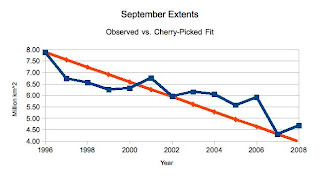 And from eye-inspection of it, it even looks like the average error is about 0. Sometimes high, sometimes low. This trend is for ice pack extent to lose about 330,000 km^2 per year, against the about 78,000 km^2 that is computed for a linear trend by climate scientists. Clearly climate scientists are trying to hide the decline!
I've already done some things more honest than what the 'no warming since 1998' folks do, not least is, I showed you the trend line and the data. But this is far from sufficient to have a reasonable trend analysis.
The method used to claim that there's a cooling trend, or no warming trend, is to cherry-pick a too-recent start year that is exceptionally high and compute the difference between that and a particular recent year (any one, repeat the 'no cooling trend for the last decade' for years afterwards, even if more recent years are warmer).
So I'll take a recent year that had large sea ice extent -- 1996, and compute the trend between there and a recent year that had a low extent -- 2007. Here's the straight line computed that way, plotted against the observations between 1996 and present. These data are September ice extents from the NSIDC:

I've already done some things more honest than what the 'no warming since 1998' folks do, not least is, I showed you the trend line and the data. But this is far from sufficient to have a reasonable trend analysis.
22 July 2011
Reconsidering forecasts and wagers
Comments in two different threads suggest that there's some good room for more discussion. Yesterday, I noted that if someone would only take a bet at 50 to 1 odds, he wasn't very confident about his side of the bet. Certainly not the 'just as likely to warm as cool' that was the statement which prompted the bet. (Nobody here, by the way.) As M commented, and I assume that he mean in terms of real money, he'd want 5:1 odds even on an even money situation. I wouldn't mind that myself (again, I don't bet real money, but in examining the mathematics of expectation, that's how it goes).
For illustration of a concept that was in my mind, but not in the prior post, I'll pick up with Alastair's comments about his predictions and preferences for odds. The thing is, the odds that you're willing to accept also describe what you think is really the case. At least it's much closer than in the case that your lunch money is riding on the bet and you're already hungry. Our situation here is betting something that doesn't exist (quatloos) and presuming that we can make a lot of bets, so that we can average out the wins and losses over time -- converging towards the mathematical situation.
I make use of this in group settings when lunch place selection is being discussed. In a group of, say, 6, all will claim to have no preference between places A and B. I pull out a coin and say, fine, heads it's A, tails it's B. An amazing number of people suddenly develop a preference for one or the other.
So it goes with Alastair's estimate of 3.9 million km^2 against mine of 4.4. His original estimate for uncertainty was 0.1 million km^2, while mine was 0.5 million. I'll add a curve for him, where the uncertainty is increased to match mine; that'll be the 'Alastair-2' curve:

For illustration of a concept that was in my mind, but not in the prior post, I'll pick up with Alastair's comments about his predictions and preferences for odds. The thing is, the odds that you're willing to accept also describe what you think is really the case. At least it's much closer than in the case that your lunch money is riding on the bet and you're already hungry. Our situation here is betting something that doesn't exist (quatloos) and presuming that we can make a lot of bets, so that we can average out the wins and losses over time -- converging towards the mathematical situation.
I make use of this in group settings when lunch place selection is being discussed. In a group of, say, 6, all will claim to have no preference between places A and B. I pull out a coin and say, fine, heads it's A, tails it's B. An amazing number of people suddenly develop a preference for one or the other.
So it goes with Alastair's estimate of 3.9 million km^2 against mine of 4.4. His original estimate for uncertainty was 0.1 million km^2, while mine was 0.5 million. I'll add a curve for him, where the uncertainty is increased to match mine; that'll be the 'Alastair-2' curve:

21 July 2011
Sea Ice Wagers
I'll hang out the shingle here for folks who want to talk about sea ice wagers with me. Keep in mind that I don't bet real money, quatloos instead. Call them points of honor.
I don't take any of this very seriously. Seriously enough to mention that so far, I have won all my wagers of quatloos.
The serious part is how rapidly pseudoskeptics leave the room if one raises even a casual honor bet that takes their statements seriously. People who claim that temperatures are just as likely to go down as up demand 50:1 odds if challenged to a bet on whether temperatures will go up or down. If they believed what they were saying, they'd take 1:1 odds, and be happy with either side of the bet.
Last fall as I was evaluating the seaice ... statements from Wattsupwiththat , Joe Bastardi declared (over there) his belief that September 2011 ice would be at least 5.5 million km^2. If anyone can find Bastardi's address, I would be happy to bet quite a few quatloos with him. If he believed what he said, he should pay off infinity to my 1 if ice is less than 5.5 million km^2. I'll pay him 1 if it's over.
I don't take any of this very seriously. Seriously enough to mention that so far, I have won all my wagers of quatloos.
The serious part is how rapidly pseudoskeptics leave the room if one raises even a casual honor bet that takes their statements seriously. People who claim that temperatures are just as likely to go down as up demand 50:1 odds if challenged to a bet on whether temperatures will go up or down. If they believed what they were saying, they'd take 1:1 odds, and be happy with either side of the bet.
Last fall as I was evaluating the seaice ... statements from Wattsupwiththat , Joe Bastardi declared (over there) his belief that September 2011 ice would be at least 5.5 million km^2. If anyone can find Bastardi's address, I would be happy to bet quite a few quatloos with him. If he believed what he said, he should pay off infinity to my 1 if ice is less than 5.5 million km^2. I'll pay him 1 if it's over.
Subscribe to:
Posts (Atom)

 Posts
Posts


